
Smart Glass Office Design: 7 Top Specs (2026)

Architects and designers spec’ing modern LA office spaces in 2026 face a privacy-and-daylight tension that previous-generation glazing couldn’t resolve cleanly. Open floor plans want maximum daylight and visual connection; conference rooms and executive suites need confidential privacy on demand. Smart glass office design is the spec that resolves that tension at the architectural level — privacy as a controllable layer, daylight as the default state.
This guide walks the seven specs we run on every architect and designer consult. Each comes from real LA-area office projects we’ve shipped in the last 12 months — Class A new construction, creative-tech tenant improvements, and full-floor remodels across DTLA, Beverly Hills, Culver City, and the Westside.
Why Switchable Glass Belongs at the Architectural Layer
The discipline isn’t an add-on or a furniture-level decision — it’s an architectural-spec layer that gets decided during the glass-and-glazing phase of the build. Designed-in switchable glass on conference rings, executive suites, and partition walls reads as native to the building’s architecture rather than retrofit. The seven specs below are the design-time decisions that distinguish a well-spec’d switchable-glass office from a retrofitted one.
The 7 Design-Phase Specs
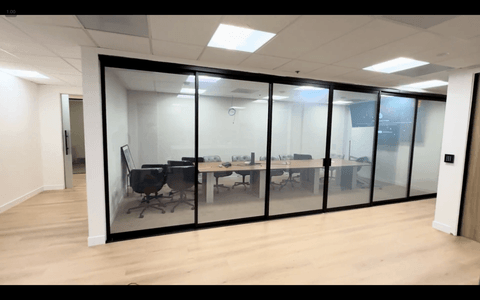
- 1. Frameless conference-room glass walls. Modern office design favors frameless or minimal-frame glass on conference-room walls. The hidden electrical layer of laminated smart glass concealing the bus-bar inside the assembly delivers a cleaner architectural read than retrofit film with visible edge wiring. Decide frameless vs framed at glazing spec, not at install.
- 2. Floor-to-ceiling glass partitions for executive suites. Higher-end LA office projects increasingly spec floor-to-ceiling glass partitions for executive suites — privacy when needed, openness as the default. Switchable spec on these partitions integrates the privacy layer into the floor-to-ceiling architectural read without curtain track or blind hardware breaking the line.
- 3. Curved and shaped-glass spec. Modern Class A buildings increasingly use curved glass on entry vestibules, atrium walls, and signature spaces. Pre-laminated curved smart glass supports privacy spec on these architectural features without compromising the curve geometry. Decide pre-laminated curve vs flat-glass-with-film during the design phase.
- 4. Daylight-zone planning around switchable glass. Architectural-level coordination with daylight planning — west-facing conference rings frost during peak afternoon glare, east-facing partitions stay clear for morning daylight. The mechanical and lighting consultants need glazing performance data during design development — manufacturer spec sheets cover the film and panel formats, and Smart View’s NFRC-rated smart glass picture windows carry certified U-Factor and SHGC ratings.
- 5. BMS-integrated control architecture. Class A and B+ projects spec the BMS integration during design — Crestron, Lutron, or Savant control surfaces decided alongside the glass spec. Late-stage BMS integration is significantly more expensive than early-design integration; the wiring and driver locations get decided during the building’s electrical-design phase.
- 6. Acoustic glass pairing for confidential rooms. Architectural coordination of visual privacy with acoustic privacy — laminated or double-pane assemblies with the switchable layer applied to one face. Conference rooms and executive suites need both; pairing the spec during design prevents the half-solution of visual-privacy-only that retrofit installs sometimes deliver.
- 7. Reception and lobby spec for first-impression read. Reception and lobby glass increasingly carries switchable spec as part of the building’s brand-and-arrival sequence — clear during business hours, branded-frosted with custom-cut wordmarks after hours. The architectural read shifts from “office building lobby” to “branded entry sequence” depending on the time of day.
For technical context on the underlying switchable-glass technology that supports the seven design specs above, see our smart glass PDLC page — covers the spec details that determine product behavior under any architectural design context.
Where the Spec Pays Back Most Clearly
Across the LA-area commercial installs we ship, the architectural spec earns its cost back fastest on three project types:
- Class A new construction with frameless glass architecture. Specs #1 (frameless conference walls) and #3 (curved and shaped glass) compound — the laminated smart glass aesthetic clears the retrofit-film aesthetic on these design-forward projects.
- Creative-tech tenant improvements with daylight-forward design intent. Specs #2 (floor-to-ceiling partitions) and #4 (daylight-zone planning) compound — the open-floor-plus-private-rooms tension resolves cleanly through architecturally-integrated switchable spec.
- Higher-end law and finance offices with confidentiality requirements. Specs #5 (BMS integration) and #6 (acoustic pairing) compound — the regulated-vertical office mix requires both visual and acoustic privacy spec, and the BMS integration supports the after-hours and per-room control patterns these tenants expect.
How These Specs Compound Across a Floor
The seven specs above don’t sit in isolation — on a typical Class A floor (15,000–25,000 sq ft, 30+ glass partitions across conference rooms, executive suites, partition walls, and reception), four to six of them compound on the same project. The architectural-design discipline scales cleanly because the underlying product is the same — only the per-surface design context differs.
For multi-surface design projects, this means a floor-wide architectural standard can serve very different room contexts under one design vocabulary — frameless conference rings, floor-to-ceiling executive partitions, curved entry vestibules, BMS-integrated control across all of them. The architectural read becomes coherent rather than retrofitted.
Designed-In vs Retrofit: Real Project Math
For a typical Class A floor with switchable spec integrated during glazing (~400 sq ft of glass across conference and executive surfaces), the spec is quoted in writing after a measurement when designed-in during construction. Equivalent retrofit on the same surface count after construction costs significantly more because of the demolition labor on already-installed glass — designed-in switchable glass typically runs 20–30% below retrofit cost on identical scope.
The aesthetic gain on frameless and curved-glass specs (#1 and #3) is hard to quantify but real — Class A leasing tours respond to the architectural read, and the spec contributes to the building’s amenity package documentation.
A Beverly Hills Conference-Room Reference
For a concrete example of the design playbook applied end-to-end on a single project, our Beverly Hills conference-room install hits five of the seven specs directly. Frameless conference glass (spec #1), floor-to-ceiling executive partitions (spec #2), BMS integration via Crestron (spec #5), acoustic glass pairing on confidential rooms (spec #6), and reception-area branded-frost spec (spec #7) — all designed-in during the architectural phase rather than retrofit.
Full project breakdown: smart glass conference rooms in Beverly Hills — a Class A office implementation of the playbook.
Planning a Switchable Glass Spec for Your Office Project?
Outside the LA metro? We supply film and glass materials per project and guide your licensed installer on the spec. Get in touch through the contact page with your dimensions and we will confirm what fits and what it costs.